A stroller part lives a hard life: thousands of actuations, direct summer sun, hot car trunks, freezing sidewalks. Most “printed part broke on me” stories trace back to one mistake: the wrong plastic. Here’s the ranking that governs our catalog.
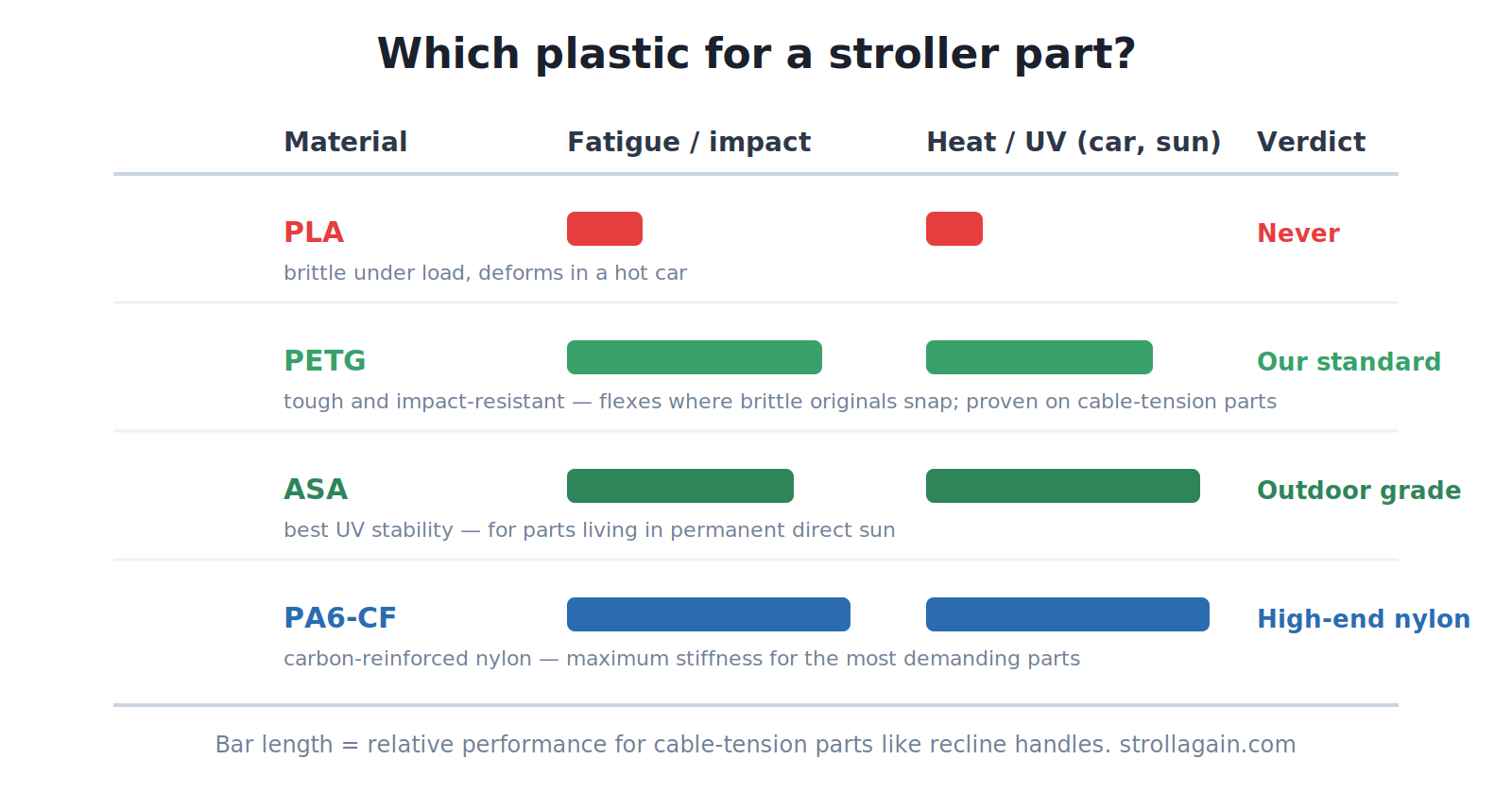
PLA — never on a stroller
The default hobby plastic. It prints beautifully and fails miserably outdoors: it’s brittle under repeated load and starts deforming at temperatures a parked car reaches in spring. Community repair attempts in PLA consistently end in a re-broken part.
PETG — our standard, and for a reason
Tough, impact-resistant and weather-stable, PETG has a property the original brittle plastics lack: it flexes under stress instead of snapping. On a part that failed from fatigue cracking — like a recline handle’s cable anchors — that slight give is exactly what you want: the load spreads instead of concentrating on a crack tip. Printed with the right orientation and reinforced walls, PETG is the material of every part in our catalog, including cable-tension parts like recline handles.
ASA — the full-sun material
For reference: ASA is mechanically close to the ABS used in original stroller parts, with the best UV stability of the group. It’s what you’d reach for on a part living in permanent direct sunlight year-round.
PA6-CF — the high-end nylon
Also for reference: carbon-fiber-reinforced nylon offers maximum stiffness and temperature stability, and community repairs of the Cybex recline handle in PA6-CF have been reported as more durable than the original part. It’s overkill for most stroller parts — well-designed PETG covers their real load cases — but it shows how far above the original plastics a printed part can go.
Material isn’t everything
Print orientation (layer lines out of the stress path), wall count and design reinforcements matter as much as the plastic. That’s the difference between “a printed part” and “an engineered replacement part”. Related: are printed stroller parts safe?